

Post date 12 Jan 2026 (original LinkedIn date)
Original LinkedIn version· 1,210 words

Timber, agriculture and nature-based solutions are frequently lumped together as investments. But is that fair? Are they truly fungible? Or do they, in terms of risk and return, instead complement one another?
Timber and agriculture are extractive, yield-focused investments with established return profiles but face increasing scrutiny over environmental impact and commodity-price volatility, whereas UK nature-based solutions (BNG, nutrient neutrality, natural flood management) are restorative, in-part compliance-driven markets that can address acute business-resilience needs, unlocking stalled housing developments, protecting supply chains from flooding, meeting statutory biodiversity requirements, making them lower regulatory risk than voluntary carbon markets in the Global South and increasingly essential infrastructure rather than speculative plays.
But let’s pear them back to their essential return characteristics. How do trees, fields, and wetlands become investments? More importantly: what returns should you actually expect, and what’s actually being taken from them? I get asked these questions more often these days and they are becoming urgent. As net-zero commitments multiply and climate policies tighten, serious institutional capital is starting to move meaningfully into UK nature-based assets. But lumping timber, farmland, and carbon credits together misses something crucial: their return profiles, fee structures, and risk exposures are splitting apart.
Let’s dig into each in turn.
The timber story: steady growth, but fees matter
Traditional timberland has long been the boring, reliable cousin of alternative investments. The components are well-understood. Academic research (Caulfield’s framework, reaffirmed by recent studies) shows timberland returns decompose into three core sources: biological growth (~60%), timber-price appreciation (~33%), and land appreciation (~6%).
But here’s what often goes missing in pitch decks: those headline returns assume you’re holding the asset directly. Once you buy through a timber REIT or TIMO (Timber Investment Management Organisation), fees can start to eat into performance.
Timber returns attribution (before fees)
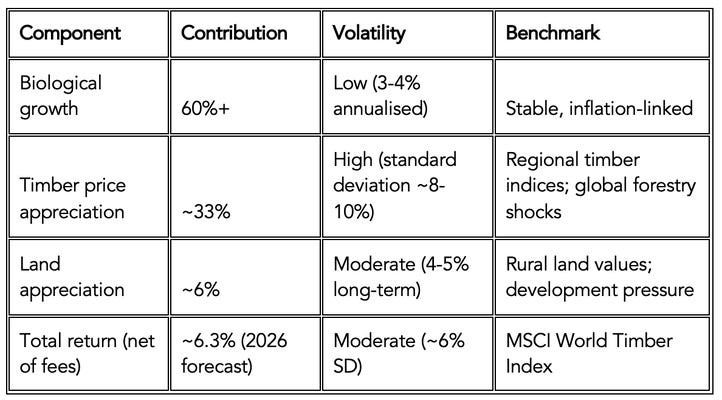
The catch: timber REIT fees typically run 1.0-1.25% annually, whilst private TIMOs charge 0.75-1.5%, and of course that 100-basis-point headwind compounds. A 6.3% headline return becomes ~5.0-5.5% net.
Farmland: income squeeze, asset appreciation resilience
Industrial agriculture decomposes somewhat differently. Farmland returns typically split between cash yield (income) and land-price appreciation. Overall, the two components deliver a historically clean 1.5-4% cash yield plus 4-6% annual land appreciation. But 2026 could be different. Commodity prices have cratered. Input costs (fertiliser, fuel, labour) remain stubbornly high. It’s not much of a stretch to imagine that this potentially squeezes the income leg.
Farmland returns attribution (2026 outlook)
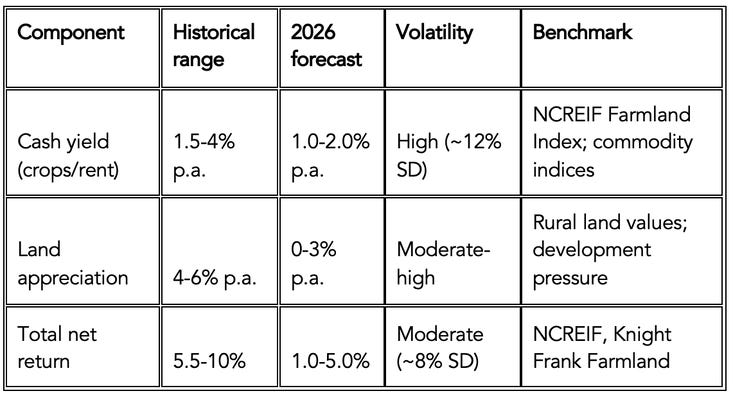
But the good news is that land values themselves are holding up. Why? Limited supply and intense institutional demand. That’s the real asset anchor at work.
The fee picture varies. Farmland REITs charge 0.4-0.8%. Direct investment through funds typically attracts fees of 1.0-2.0% for management, plus hurdle rates. Net that out, and you’re possibly looking at a 3-5% net return in 2026, below historical norms, but not a disaster if you believe in long-term appreciation.
Carbon credits: high potential, high volatility, and policy risk
The voluntary carbon market is projected to explode from $2.5bn (2023) to $250bn (2030) despite political headwinds arriving across the Atlantic. Some forecasts suggest prices could consistently rise above £100 per ton. While that’s potential for serious price appreciation, we should be honest and recognise that it’s also potential for serious volatility.
And we know what the market is lacking: standardisation and price transparency. Quality premiums vary wildly. Some credits trade at $5; others at $100+. Downside-capture risk is real. If climate policy rolls back, or corporate net-zero commitments waver, prices crater.
A risk consideration suggests standard deviation on voluntary carbon credits is estimated at c.15-20% annualised. Correlation with equities is low, which sounds good … until it isn’t. In a 2008-style liquidity crisis, might exit options be expected to evaporate? There’s no NCREIF index to anchor you. As a consequence, the Sharpe ratio for pure carbon plays can be challenging, even with high headline returns.
The plot twist: functional nature markets
But here’s something many investors miss: the real opportunity might be closer to home, and it’s less volatile because it’s in part regulatory, and drive by considerations of business resilience.
Biodiversity Net Gain (BNG) became mandatory in February 2024. Developers must deliver 10% biodiversity uplift or buy credits from landowners. This isn’t hypothetical. Over 21,000 acres are already allocated; prices are robust. Even with recent policy tinkering, there’s still something there.
UK nature markets
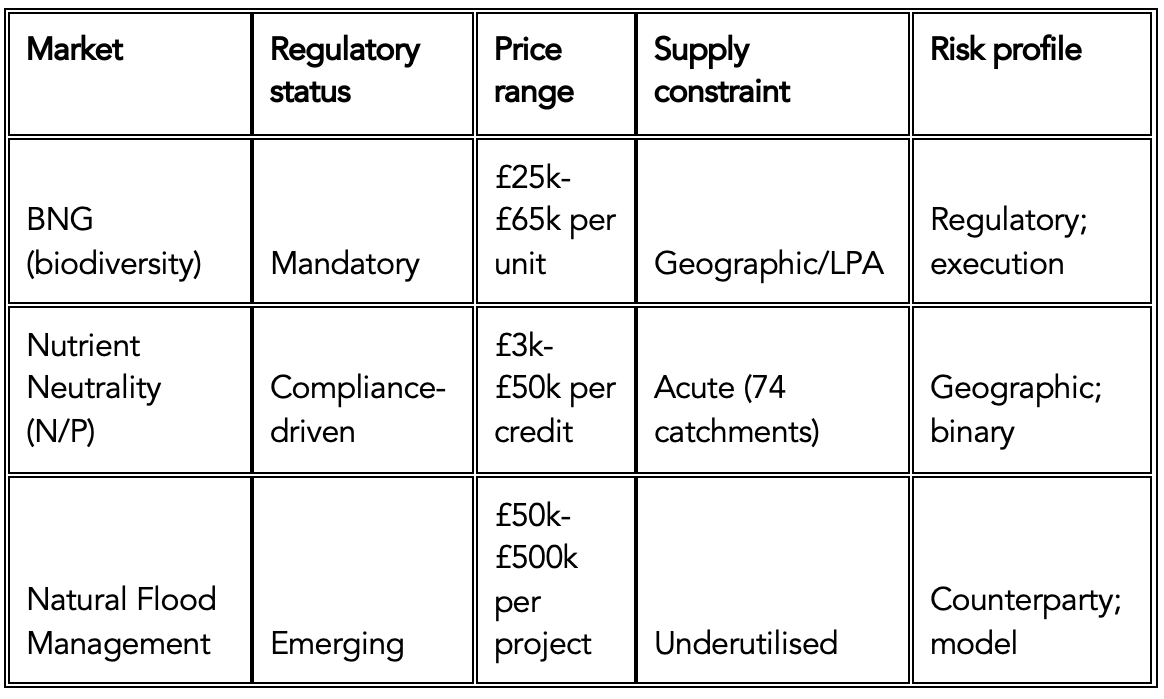
These markets are different because they address immediate, local regulatory and business risk hurdles. A developer can’t simply wait for prices to drop; they need units to get planning permission. A manufacturer cannot afford to have their premises flood on an increasingly frequent basis. Demand is inelastic.
That said, nutrient neutrality is geographically binary. Your land is either in a designated catchment or it isn’t. BNG is spatially constrained - units generated far from the development site face a ‘spatial risk multiplier’ (penalty), requiring more land to generate saleable credits.
Rand there’s still regulatory risk. If BNG requirements loosen or nutrient-neutrality rules are softened, supply floods the market and prices crater. But challenges to supply change and the need for adaptation remain consistent.
The hidden costs: fees, liquidity, tax
Let’s be honest, most marketing decks omit three things:
1. Fees: management charges compound. A 1% annual fee on a 12% return eats almost 8% of your income. Over 10+ years, it’s material.
2. Liquidity: private-market timber, farmland and nature-based solutions all have long lock-up periods (10-15 years). Secondary-market pricing can be opaque. Early exit penalties can be brutal, sometimes 5-10% of principal, so check the small print!
3. Tax: is this where surprises hide? Timber investment benefits from depreciation deductions. Farmland from conservation easements. Carbon credits from specific green-investment schemes. Understand your rules or leave money on the table.
The real play: stacking returns, managing risks
Current regulations allow you to bundle BNG and nutrient-neutrality credits on the same plot. One hectare, multiple revenue streams. But stacking increases complexity. You’re now juggling three regulatory bodies, three approval processes, three sets of monitoring requirements, and three market-price exposures. Don’t underestimate the work that needs to be done in diligence to get properly comfortable.
Nonetheless, the return potential is genuine. The diversification benefit is real too - uncorrelated revenue streams reduce portfolio volatility. And we still haven’t done the work to properly quantify the tail risk hedging benefits (with positive carry) on the rest of the portfolio (the public equity and debt allocations).
What happens next?
Nature-based investing isn’t a monolith. Timber offers stability but arguably shrinking net returns and increasing liquidity premiums. Farmland offers long-term appreciation but 2026 and near-term potentially income faces headwinds and you shouldn’t ignore the positive correlation with equities. Carbon offers growth with volatility and policy risk. Emerging UK nature markets offer regulatory certainty with geographic constraints. Understanding these differences shapes portfolio construction, risk management, and realistic return expectations.
Benchmark your allocation against MSCI World Timber, NCREIF Farmland, and commodity indices, not just headline returns, but Sharpe ratios and downside capture.
Price in the fees. Scenario-test policy changes. Understand your liquidity constraints.
I imagine that the next five years will truly settle that these emerging nature markets can properly scale beyond mere niche opportunities. But one thing’s clear: there’s good reason to lump all nature-based assets (old and new) together – their return drivers are all quite different.