

Post date
30 May 2025 (original LinkedIn date)
Original
LinkedIn version· 666 words

Positioning Natural Capital at the core of 21st century portfolio strategy
An opening thought
Two wonderful days spent at the Scottish Centre for Ecology and the Natural Environment, seeking to resolve the issue of marine natural capital markets, in some inspiring company and in an inspiring environment, my journey home allowed me time to ponder: can nature be more than just an asset class? Well, of course it is, much more, but my angle is from the investment perspective. Nature is finally being recognised not only as a source of risk, but as a source of value. Recent statements by the European Central Bank make clear that biodiversity and ecosystem degradation pose systemic financial threats. Yet embedded within that risk is a rare opportunity: to invest in nature as a real asset class, one that generates long-term yield, mitigates downside exposure elsewhere in the portfolio, and appreciates in both ecological and economic value over time.
Nature as a real asset class
Nature-based solutions (NbS), from peatland restoration to oyster reef restoration, share many characteristics with conventional real assets. They are:
Tangible: land, habitats, hydrological systems, and ecosystems.
Long-term: 30–100 year revenue profiles.
Service-generating: providing measurable flows of carbon storage, flood protection, water purification, biodiversity uplift, and more.
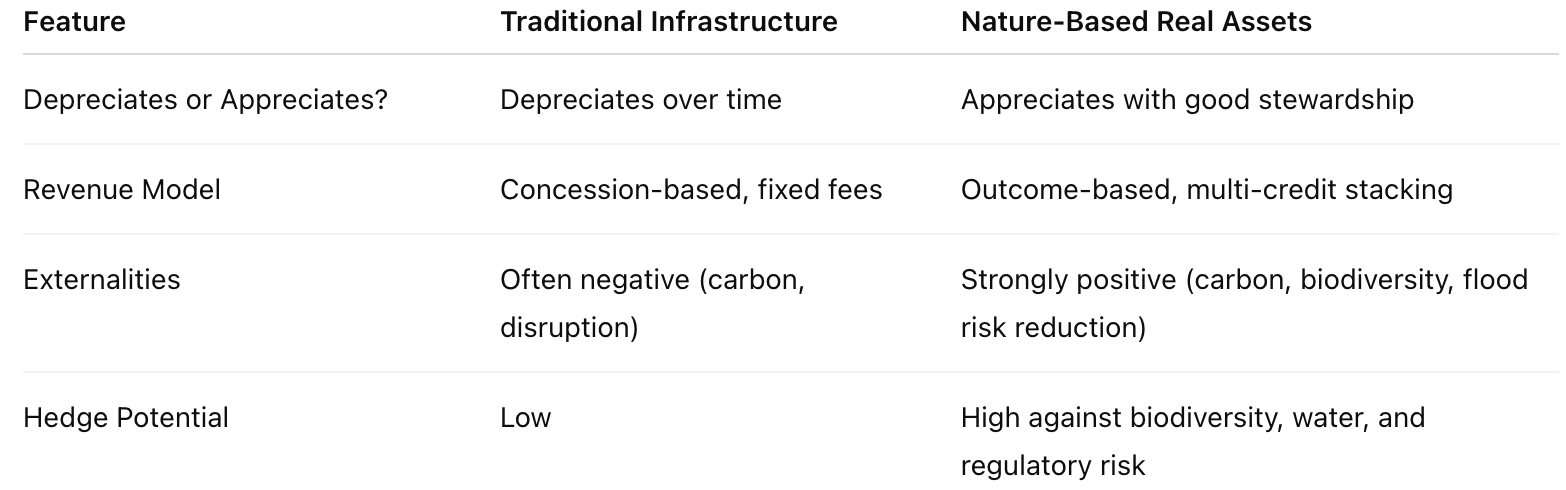
But nature differs in one crucial respect: it regenerates. Properly stewarded, it appreciates, both ecologically and economically. This contrasts with hard-engineered infrastructure (roads, bridges, pipes), which deteriorates and demands periodic capital-intensive renewal. In effect, natural capital is a self-repairing asset, (if we could only turn from a purely extractive mindset), especially when protected and managed through outcome-based mechanisms.
As ecosystem services increase, so too does the value of the associated nature asset - and the payment streams it unlocks: carbon credits, biodiversity units, water quality trading, sustainable harvests, and ecosystem-linked insurance savings.
Nature as a portfolio hedge
Most portfolios are overexposed to the downside of nature loss, and underexposed to its upside.
Sectors such as agriculture, consumer goods, pharmaceuticals, water utilities, and real estate all rely on stable, functioning ecosystems. Yet these dependencies are rarely hedged. In this context, natural capital investments provide a rare form of functional insurance:
When biodiversity collapses, conventional holdings in nature-dependent sectors suffer.
But in those same conditions, restored ecosystems and their associated credits increase in scarcity and value.
This creates a positive convexity: nature-based assets perform better in the very scenarios that harm the rest of the portfolio. They are negatively correlated with nature degradation risks, while still offering market-rate returns in base-case conditions. Few other assets do this.
ECB research shows over 70% of euro area firms (I suspect this figure is closer to 100%!) depend directly on ecosystem services. Climate-related drought, water scarcity, and species collapse now represent tangible tail risks to macroeconomic and financial stability. Investing in ecosystem restoration is no longer just impact, it’s financial prudence.
A new asset for a new economy
Nature-based assets are emerging as a cornerstone of next-generation portfolio construction. I believe that the case rests on four important pillars:
Making Nature investable
The barriers are falling. Nature is being made open to capital via:
Measurement frameworks: SEED Index, TNFD, Nature VaR.
Market mechanisms: UK Biodiversity Net Gain, Woodland & Peatland Codes, blue carbon registries.
Policy momentum: EU Nature Restoration Law, Sustainable Finance Disclosure Regulation (SFDR), and growing integration by central banks.
With return expectations of 8–10% IRR net over 10–15 years increasingly viable through diversified cash flows and blended finance structures, natural capital is entering the mainstream.
A closing thought
To borrow from (Member of the ECB’s Executive Board) Frank Elderson’s recent remarks: the bell tolls not just for the economy, but for finance itself. A portfolio that ignores nature risks compounding losses. But a portfolio that allocates to nature stands to gain on both fronts - financial resilience and ecological regeneration.
Nature is no longer a cost centre. It is an appreciating, productive asset. And it may prove to be the most strategic hedge of all.