

Post date 2 Nov 2026 (original LinkedIn date)
Original LinkedIn version· 2,160 words

‘All I need’ by Air featuring Beth Hirsch, released as a single in 1998 and on their debut album ‘Moon safari’ – last heard strolling thru Athens airport with Neil Entwistle on the way home from Armenia.
I came to COP17 naturally expecting to hear a great deal about biodiversity targets, conservation finance and the formidable gap between global ambition and delivery. And indeed I did and you can read about the outcomes here: https://www.carbonbrief.org/cop17-key-outcomes-agreed-at-the-un-biodiversity-conference-in-yerevan. But walking between meeting rooms and pavilions in Yerevan, I also kept hearing another language: Nature as infrastructure. Wetlands as water infrastructure, investment in resilience, adaptation, healthy watersheds, catchments, and blended finance. For someone who has spent much of the past several years arguing that nature should be understood and financed as productive infrastructure, it was music to my ears.
This was not confined to one speaker or one corner of the conference. It appeared repeatedly across the programme. From a session titled “Wetlands as Natural Water Infrastructure for Delivery of the Kunming–Montreal Global Biodiversity Framework”, thru the TNFD Hive hosted discussions on “Financing nature as infrastructure” and mobilising business and finance in a world of declining nature resilience, to another workshop covering “From Value Bundling to Co-Finance”. There were sessions on financing healthy watersheds, freshwater biodiversity from water towers to wetlands, climate adaptation in protected areas, resilient cities and nature-based solutions for water security. The launch of the Yerevan Platform on Mountains and Related Freshwater Ecosystems went further, describing mountain ecosystems as strategic natural infrastructure supporting communities and economies far downstream.
The cumulative effect? Well this was a biodiversity COP, but to me many of its most interesting conversations were really about how societies continue to function in the face of drought, flood, heat, ecosystem degradation and growing economic uncertainty.
More than a change in language
It would be easy to dismiss this as a rebranding exercise: familiar conservation activity presented in the more muscular language of infrastructure and resilience, but I think that would miss something important. Traditional infrastructure is valued not simply because it exists, but because of what it enables. Reservoirs store water, drainage systems manage rainfall, and sea walls reduce coastal risk. Electricity networks keep homes, hospitals and businesses operating. Their value lies in the dependable services they provide to identifiable users.
Natural systems also perform economically essential functions. Wetlands hold and filter water, floodplains create room for rivers, and healthy soils retain moisture. Peatlands regulate flows and store carbon, forests stabilise slopes and influence water quality and quantity, while dunes, saltmarshes and reefs reduce coastal exposure. These are not incidental environmental benefits, rather they are part of the systems through which places obtain water, manage hazards, produce food and adapt to a changing climate.
That was also the message from the financial-policy end of COP17. Opening Finance and Biodiversity Day, the European Central Bank’s Frank Elderson compared natural capital with the roads, bridges and power grids on which modern economies depend. His central point was that protecting and restoring nature should be understood not merely as expenditure, but as investment in economic resilience and future prosperity. My good friend Luke Baldwin often talks about the need for a common language and he is right for language matters because language shapes institutions. If nature is principally treated as an amenity or a charitable cause, it will compete for constrained environmental budgets. If it is recognised as part of the infrastructure on which water security, asset continuity and economic activity depend, a much wider set of budgets, beneficiaries and investment cases comes into view.
The finance gap is not only a shortage of capital
Let’s be honest, CBD COP17 took place against a sobering backdrop. The first global review of progress under the Kunming–Montreal Global Biodiversity Framework shows that the world remains a really long way from mobilising the finance required for 2030. Private finance has not accelerated at the pace many hoped it would. The familiar (and perhaps rational) response is to call for more capital, but this can obscure the more fundamental constraint. There is already substantial interest among investors in nature, resilience and adaptation. What is often missing is not willingness to invest, but an investable proposition: a clearly defined service, an accountable purchaser, a durable source of revenue and a sensible allocation of risk.
We would not expect private capital to finance a water-treatment plant without knowing who will buy its services. Yet nature projects are frequently expected to become investable on the strength of their environmental merits and a calculation of their total social value. Value is essential, but it is not the same as cash flow. A restored wetland may reduce flood risk, improve raw-water quality, support biodiversity, store carbon, provide amenity and reduce pressure on drainage infrastructure. Those benefits can be substantial, but they accrue to different organisations, communities and budgets. Unless some of those beneficiaries can purchase defined outcomes over time, the project remains socially valuable but financially difficult.
This is why the phrase “from value bundling to co-finance” caught my attention. The description of that COP17 session identified the problem precisely: nature’s benefits are absorbed in a scattered way by public, private and civic actors, leaving no single, straightforward payer. Of course the answer is not necessarily to force every benefit into a market, and nor is it to sell the same outcome several times. It is to identify which beneficiaries possess both a material interest in the outcome and the capacity to contribute, then build a structure through which they can procure the relevant services together.
From disclosure to transaction
Another theme running through COP17 was the rapid development of nature-related assessment, data and disclosure. This progress is absolutely necessary. TNFD and related initiatives are helping companies and financial institutions locate their dependencies and risks. Better ecosystem data can reveal where facilities, supply chains and investment portfolios depend upon water regulation, soil health, pollination, coastal protection or other ecosystem services. But that diagnosis alone does not deliver treatment.
An organisation may discover that a production site depends on a degraded catchment, or that an asset is increasingly exposed to flood and drought. That does not tell it how to commission a landscape-scale response, how much it should pay, how its contribution should relate to those of other beneficiaries, or how performance should be verified over twenty years. I believe that that transaction layer is now the critical frontier. The sequence needs to move from a location-specific dependency, to a measurable intervention, to an attributable resilience benefit, to a contractual payment and verified performance. Without that chain, disclosure can improve awareness without materially changing the condition of the landscape on which the business depends.
This is where the idea of nature as infrastructure becomes practical rather than simply rhetorical. Infrastructure has a service specification, a delivery model, maintenance obligations and customers. Applying that discipline to natural infrastructure could undoubtedly help convert identified nature-related dependencies into long-term investment.
Water provides the clearest entry point
The prominence of water at COP17 was especially telling, as in many ways, water makes nature dependency tangible. A wetland’s capacity to hold and clean water, a mountain catchment’s role in sustaining downstream flows, or a floodplain’s ability to store rainfall can be connected to operational thresholds, vulnerable assets and identifiable beneficiaries more readily than many broader expressions of natural value. Of course that does not make measurement simple. Hydrological outcomes remain uncertain, spatially specific and influenced by weather and land use beyond any single project’s control. Natural infrastructure should not be sold through heroic promises that a wetland will prevent every flood or that better soils will eliminate drought restrictions.
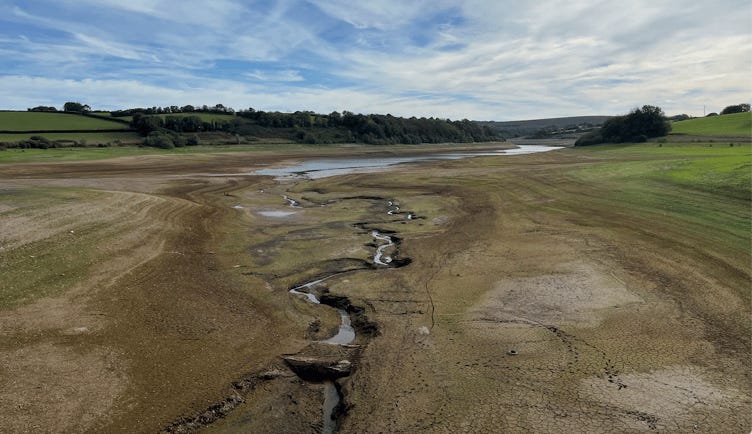
But resilience is not the same as certainty. Engineered infrastructure is also designed around probabilities, service levels and residual risk. A portfolio of natural interventions can be assessed in terms of how it changes the probability, severity or cost of disruption ... and how it complements conventional assets. This feels particularly relevant in the UK. Water scarcity, deteriorating river health, surface-water flooding and constrained utility balance sheets are no longer separate policy problems. They are symptoms of a system that needs more distributed capacity to slow, store, filter and release water across landscapes. We walked the dogs by Wimbleball Lake yesterday - this important reservoir is currently at <20%, it’s in a pretty shocking state:
The credible proposition is not nature instead of reservoirs, treatment works or flood defences. It is nature as a productive layer within the wider system: protecting raw-water quality, reducing runoff, creating storage, improving recharge and allowing engineered assets to perform better or last longer.
Financing resilience together
This is the thinking behind multi-beneficiary financing, Resilience Purchase Agreements and the Water Resilience Unit concept we have been developing. Consider a catchment in which upstream restoration could reduce flood peaks, improve water quality, strengthen drought resilience and create habitat. A water company may value lower treatment pressure and greater supply resilience, whereas a local authority may value reduced flooding and disruption. An infrastructure operator may benefit from fewer closures, and farmers may value healthier soils and more dependable water. Public nature programmes may pay for biodiversity and environmental recovery. No single beneficiary needs to pay for the entire intervention, and not every benefit needs to be monetised. The requirement is that enough parties make sufficiently dependable commitments to support delivery and long-term stewardship.
Public funding can absorb early project-development risk or purchase benefits without a natural commercial buyer. Long-term outcome agreements can provide core revenues. Private capital can finance delivery upfront, with returns linked to a diversified set of payments rather than a speculative future market for nature. This begins to resemble infrastructure finance because it is infrastructure finance – organised around services, beneficiaries, contracts and performance rather than around the sale of an environmental asset in isolation.
A useful idea, with necessary guardrails
There are, of course, risks in describing nature as infrastructure, and we should not brush them to one side. Nature has intrinsic, cultural and ecological value that cannot be reduced to its utility for an investor or asset owner. Ecosystems are living and dynamic, not machines, and their performance is less controllable than that of a manufactured asset. Local communities and Indigenous Peoples are not merely project stakeholders; they may be rights-holders, will almost certainly be knowledge-holders and are long-term stewards. The infrastructure framing should therefore expand the reasons to protect and restore nature, not narrow them. It should bring new resources to ecological recovery without implying that only benefits capable of generating revenue deserve attention.
It also requires honesty about additionality and claims. Biodiversity obligations, carbon credits, water-quality improvements and resilience payments cannot simply be stacked on top of one another without distinguishing what each purchaser is funding. Good projects will need transparent outcome accounting, credible baselines, careful risk allocation and governance that protects ecological integrity over the long term. These are not arguments against investment, rather they are requirements for doing it properly.
What I heard in Yerevan
The official theme of COP17 is “Taking action for nature”. What I heard in Yerevan was an increasingly confident second proposition: taking action for nature is also action for water security, climate adaptation, public health and economic resilience. That feels like an important shift, but recognition is only the beginning.
The next task is to convert the language of natural infrastructure into the institutions of infrastructure delivery. Who needs the service, who has authority and budget to purchase it, and what performance can credibly be promised? How should multiple beneficiaries contribute, who carries delivery, ecological and counterparty risk, and how will the asset be maintained when the initial funding has been spent? Those questions may sound less inspiring than a global biodiversity target, but maybe they are also the questions that determine whether capital can move.
I left the conversations at COP17 encouraged. Nature as infrastructure, adaptation and resilience were no longer peripheral ideas looking for a place in the biodiversity debate. They were part of the main conversation. Music to my ears. Now we need to turn the words into contracts, the contracts into investment and the investment into healthier, more resilient landscapes.
References
Convention on Wetlands. The Convention on Wetlands at CBD COP17, including the session “Wetlands as Natural Water Infrastructure for Delivery of the Kunming–Montreal Global Biodiversity Framework” (2026).
Taskforce on Nature-related Financial Disclosures (TNFD). TNFD Hive at COP17, 23–24 October 2026.
The Nature Conservancy. From Value Bundling to Co-Finance: Financing Nature-Based Solutions in Cities, COP17 session, 23 October 2026.
UN Environment Programme (UNEP). Armenia, in partnership with UNEP, launches global initiative to drive action on mountain and related freshwater ecosystems, 28 October 2026.
Elderson, F. Taking action for nature – investing in economic resilience and prosperity, keynote speech at COP17 Finance and Biodiversity Day, European Central Bank, 26 October 2026.
Convention on Biological Diversity (CBD). State of Biodiversity Action: The Global Report on collective progress, 2026.