

Post date 8 Dec 2025 (original LinkedIn date)
Original LinkedIn version· 2,847 words

What does the EIP tell us about where the current government really stand on Nature? Might we look at last week’s Environment Improvement Plan to get an accurate assessment? DEFRA’s Environment blog team are courageously positive: “a clear roadmap for restoring nature”, they announced. And they continue: “The previous plan lacked the rigour and detail to turn intent into impact. This government is determined to put that right. Our revised Environmental Improvement plan is both ambitious and deliverable.”
The section titles alone give reasons for hope: “Why we need to act now” ~ “Cleaner air for healthier communities” ~ “Boosting nature and wildlife” ~ “Protecting our water” ~ “Backing our plan with investment” ~ “Working together to deliver”. And the clinching final paragraph: “Nature is not a luxury, it is essential. Investing in nature is an investment in our future – and this Environmental Improvement Plan sets out how we’ll deliver it”. What’s not to like? Their stance is clear to all.
But perhaps all is not quite as it seems. In the ENDS Report, Catherine Early asks, “Was the revised EIP worth the wait?”. Some discussion on timings and levels of engagement ensues.
“Adding to the worry was the knock-on impact on publication of other policy due to follow in the EIP’s wake. This included the Land Use Framework, the 25-year farming roadmap, and a consultation on the government’s proposed next steps on water regulation.”, Catherine notes. “While many commentators have welcomed a clearer focus on delivery – the reason for much criticism by watchdog the Office for Environmental Protection (OEP) – questions remain over the detail”, a message that came from many of those asked for a response. Lack of quantification is mentioned, absence of clear pathways suggested.
So how does it fit with other messages emanating from government? Not ambitious enough, said Richard Benwell, chief executive of the Wildlife and Countryside Link. “For example, £500 million for landscape recovery sounds good, but that is what is needed every year, he said, not spread over 20”. “The plan also needs to be embedded across all departments, with a cross-government delivery plan, according to Signe Norberg, director of policy and public affairs at the Institute of Sustainability and Environmental Professionals (ISEP)”. Benwell concluded: “The new EIP is an improvement and was worth the effort. But it mustn’t become a plan for more plans – on chemicals, access, private investment, food and farming – it must be a plan of action. There’s no more time to waste on delivery to stand a chance of turning round biodiversity decline by 2030. The test of credibility will be whether ministers can point to tens of thousands of hectares of priority habitat under restoration by this time next year”.
To the details we must go then!
The Environmental Improvement Plan (EIP) 2025 represents the UK government’s revised roadmap for environmental delivery under the Environment Act 2021. At first glance, the document does contain significant concrete commitments, even if they are alongside notable gaps between stated ambitions and the funding mechanisms to deliver them (more of those later). So what of the practical, quantified implications rather than aspirational statements?
The EIP 2025 announcement includes several headline funding figures that directly affect the natural capital sector:
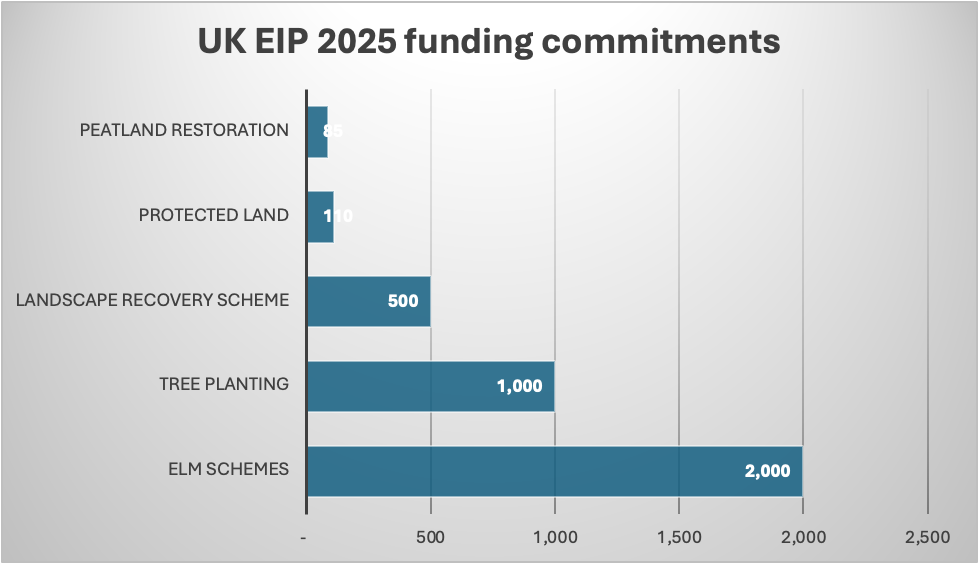
Landscape-scale nature recovery: £500 million has been committed for Landscape Recovery projects, designed to bring together farmers and land managers for large-scale habitat restoration. This represents the most substantial single commitment for landscape-scale nature work, though it must leverage additional private finance through mechanisms like Biodiversity Net Gain units and carbon credits;
Peatland restoration: £85 million allocated for improving and restoring peatlands, targeting flood reduction, water quality improvements, and carbon sequestration. Combined with £34 million from water companies for peatland schemes, this creates approximately £119 million for peatland work, though the UK has around 3 million hectares of peatland, much degraded;
Tree planting: £1 billion committed for tree planting including three new National Forests. The target is to increase woodland cover by 43,000 hectares (0.33% of land area) by 2030. Last year saw 10 million trees planted (the highest rate in 20 years), but this remains well below the scale needed; &,
Environmental Land Management schemes: funding paid to farmers will increase by 150%, rising from £800 million in 2023/24 to £2 billion by 2028/29. Over 70,000 farm businesses are now engaged across agri-environment schemes, covering approximately half of England’s farmed land.
Source: Environment Improvement Plan, 2025.
In addition, there are a string of on-the-surface impressive, private finance mobilisation targets. The government has committed to mobilise £500m of private finance annually by 2027, rising to over £1 billion by 2030. This feels a far cry from the current reality as reported at the end of 2024 by the Green Alliance: private investment in nature is estimated at just £95 million per year, mainly driven by water sector regulation, with an expected boost of £200 million annually from the mandatory Biodiversity Net Gain requirement. It also leaves a significant gap to reach the stated targets.
What about water sector investment? Ofwat’s PR24 final determinations approve £104 billion in total water sector expenditure over 2025-2030, of which £3.3 billion is allocated for nature-based solutions and increasing biodiversity. This includes £2.6 billion of storm overflow expenditure through catchment and nature-based solutions.
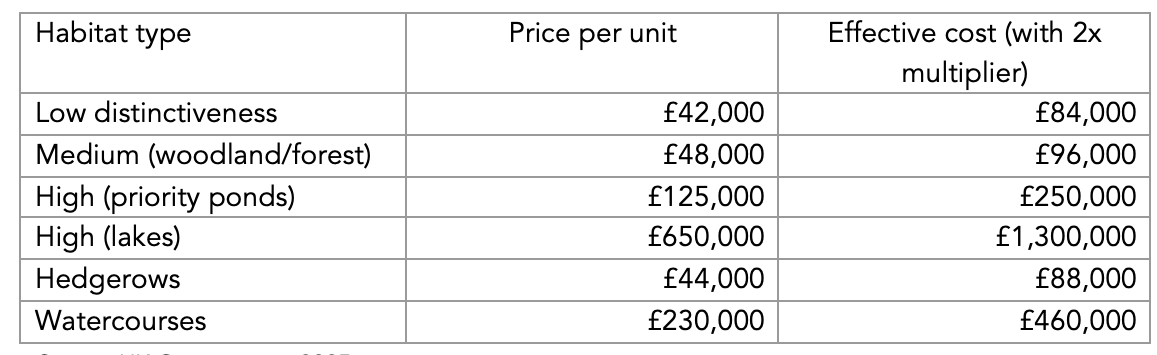
The mandatory BNG requirement, which became fully operational in 2024, creates a compliance market with substantial growth potential. The BNG market is expected to reach £3 billion by 2035 based on current habitat bank development. Over 21,000 acres of land have been allocated to BNG unit creation across England, with 93 operational habitat banks and 154 in development. Off-site biodiversity units from private habitat banks trade at £20,000–£35,000 per unit, varying by habitat type, location, and local demand, while the government has set statutory credit prices deliberately high to encourage use of the private market:
Source: UK Government, 2025.
Developers must purchase two statutory credits for every one biodiversity unit required (the spatial risk multiplier), making statutory credits a genuinely last-resort option.
The UK’s voluntary carbon markets through the Woodland Carbon Code and Peatland Code provide additional revenue streams. For the Woodland Carbon Code, average prices rose from £11.02 per tonne CO₂e in 2020 to £26.85 in 2024. The peatland carbon market remains nascent compared to its woodland cousin. Significantly greater prices appear available for carbon plus or charismatic carbon, albeit at small volumes. Additionally, the government is considering including high-quality UK woodland removals under the Woodland Carbon Code in the UK Emissions Trading Scheme, which trades at approximately £83 per tonne CO₂e, potentially tripling the value of woodland carbon credits.
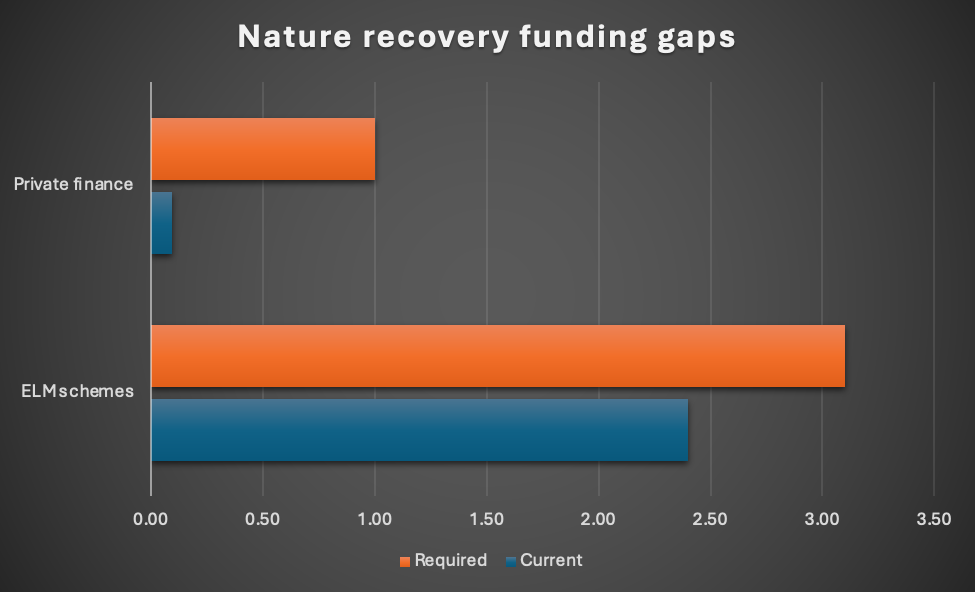
But there do appear to be nature recovery funding gaps:
Source: Leverhulme Centre for Nature Recovery, 2025.
The stark reality beneath the headline commitments reveals a substantial investment gap. Research by Oxford University estimates the UK faces a £56 billion annual finance gap for nature recovery outcomes. Current public spending on biodiversity-related projects was approximately £876 million in 2022/23, representing just 0.03% of GDP. Independent analysis by The Wildlife Trusts, RSPB, and National Trust found that £3.1 billion needs to be spent annually on nature-friendly farming and land management in England to meet legally binding targets. The current £2.4 billion budget leaves a £700 million annual shortfall. The Green Finance Institute estimated that meeting UK nature restoration requirements would require at least £44 billion over the next decade, yet private finance flows remain at approximately £95 million annually (see above).
What else is missing from the EIP 2025 to grow a natural capital market in the UK? As we have seen, it establishes ambitious targets but perhaps lacks several critical mechanisms that would enable the natural capital industry to scale at the pace required to meet net zero and 30x30 goals. Can we draw lessons from the UK’s remarkably successful renewables transformation (around a decade and a half ago) to offer a clear pathway forward?
The renewables sector transformed from a nascent industry to global leadership through one fundamental policy innovation: guaranteed long-term revenue certainty. Germany’s Feed-in Tariff (2000) and subsequently the UK’s Contracts for Difference (2013) provided investors with predictable income streams over 15-20 years, enabling access to low-cost capital and driving down technology costs.
Natural capital projects face the opposite situation. Revenue streams from BNG units, carbon credits, and payments for ecosystem services remain fragmented, volatile, and disconnected. A woodland restoration project might access Woodland Carbon Code credits, BNG units, and potentially ELM payments, but each operates under different rules, verification standards, and market conditions. There is no equivalent to a CfD strike price that guarantees a minimum return per environmental outcome delivered.
The concept of a Nature contract for difference has been proposed but is absent from EIP 2025. Such a mechanism would guarantee a strike price per verified environmental result, whether £/tonne CO₂e sequestered, £/biodiversity unit created, £/kg nutrient reduction, or similar, with government topping up if combined market revenues fall below the strike price. To make the concept more palatable to a cash-strapped government, we could add in a cap, with projects paying back if they exceed an upper bound. This would transform uncertain, back-ended income into predictable receivables that investors can get involved with.
The EIP also (re-?) announced a £30 million government investment into the Big Nature Impact Fund as ‘first loss’ capital, targeting £120 million in total. But this remains orders of magnitude below what’s needed. GFI research identified a £56 billion annual finance gap for UK nature recovery.
The contrast with renewables is stark. Germany’s KfW development bank provided billions in favourable loans for renewable installations. The UK Green Investment Bank (now privatised) mobilised significant capital for offshore wind. Yet for natural capital, there is no dedicated blended financing facility operating at scale in the UK, despite such facilities mobilising over $3 billion globally for nature recovery between 2018-2023.
The Green Alliance has specifically called for the National Wealth Fund to be reformed with an explicit mandate to invest in nature, including:
~ A new statutory duty to maintain and restore the UK’s natural asset base;
~ Nature-positive KPIs alongside existing climate targets; &,
~ Flexibility to create and manage natural capital funds directly, not just invest in third-party funds.
Without a substantial increase in concessional public capital deployed strategically, private finance will not flow at the scale required.
The Biodiversity Net Gain framework has created compliance-driven demand, but only from the construction sector (noting that infra will be added to developers in May next year). The EIP contains no mechanism to extend mandatory nature markets to other high-impact sectors. TheCityUK and the Green Finance Institute have both recommended expanding mandatory nature markets beyond property development, potentially including agriculture, energy, and water. Again the renewables parallel is instructive. The Renewables Obligation initially applied to electricity suppliers, creating economy-wide demand that justified supply chain investment. BNG applies only to major developments (getting larger as smaller projects are excluded), creating a market estimated at £135-274 million annually, far below the scale needed.
Another critical barrier identified by multiple stakeholders is uncertainty around stacking, bundling or nesting (take your pick!) of nature and carbon credits. Currently, the rules on whether landowners can receive payments from BNG, carbon codes, and public schemes simultaneously are unclear and vary by scheme. This creates:
• Missed revenue opportunities for landowners;
• Reduced investibility of projects that could generate multiple ecosystem services; &,
• Complexity that deters smaller land managers from market participation.
The Nature Markets Framework mentions stacking principles but does not provide the operational clarity needed. The EIP 2025 fails to resolve this fundamental barrier to project viability. Equally double-counting must be strictly avoided, with market-wide rules around additionality carefully crafted.
Perhaps the single highest-impact policy change for the natural capital industry would be integrating high-quality UK woodland carbon credits into the UK Emissions Trading Scheme. The UK ETS currently trades at approximately £83 per tonne CO₂e, compared to roughly £30-40 for Woodland Carbon Code credits. Integration could potentially:
• Potentially triple the value of woodland carbon credits;
• Create compliance-driven demand from industrial emitters; &,
• Provide price signals that would unlock significant private investment in afforestation.
A consultation on this integration attracted around 160 responses and is being considered by the ETS Authority. The decision remains pending, with some stakeholders expressing concerns about permanence and EU ETS linkage compatibility. However, new evidence from DEFRA and Forest Research indicates woodland removals could represent up to 10% of UK residual emissions reductions by 2050. The EIP 2025 does not commit to ETS integration for woodland carbon, leaving this critical price signal absent. We could also follow the lead of the Japanese government with their J-Blue credit framework, allowing for the inclusion of the marine environment in the UK’s Nationally Determined Contribution.
The renewables industry benefited from clear procurement pipelines. Offshore wind developers knew auction rounds were coming, could plan supply chains, and aggregate projects to achieve bankable scale. Natural capital has no equivalent today. Current barriers include:
• High upfront costs for project development and feasibility studies;
• Small project scale making individual sites unbankable;
• Lack of standardised project templates and technical assistance; &,
• No visible procurement pipeline for nature restoration at scale
The Green Finance Institute’s ‘roadmap’ identifies that “the risks of investment at scale currently outweigh the returns” due to systemic undervaluation of nature, lack of tested revenue streams, and expertise gaps. The EIP mentions landscape-scale projects but does not create the aggregation platforms and project development support that would build a visible pipeline of investable opportunities.
TCFD-aligned climate disclosures became mandatory for large UK companies in 2022, creating corporate accountability for climate risks. The equivalent for nature, TNFD-aligned disclosures, yet remains voluntary. The Aldersgate Group and others have called for government to set out an iterative roadmap to mandatory TNFD-aligned disclosures, which would:
• Drive corporate demand for nature-positive investments;
• Create accountability for nature-related financial risks; &,
• Build capacity in the financial sector to assess nature dependencies.
The EIP 2025 does not commit to mandatory TNFD implementation, leaving corporate nature accountability voluntary still.
The UK’s offshore wind cost reduction, from £150/MWh to £37/MWh in under a decade, resulted from specific, replicable policy choices – they could be mirrored for Nature:
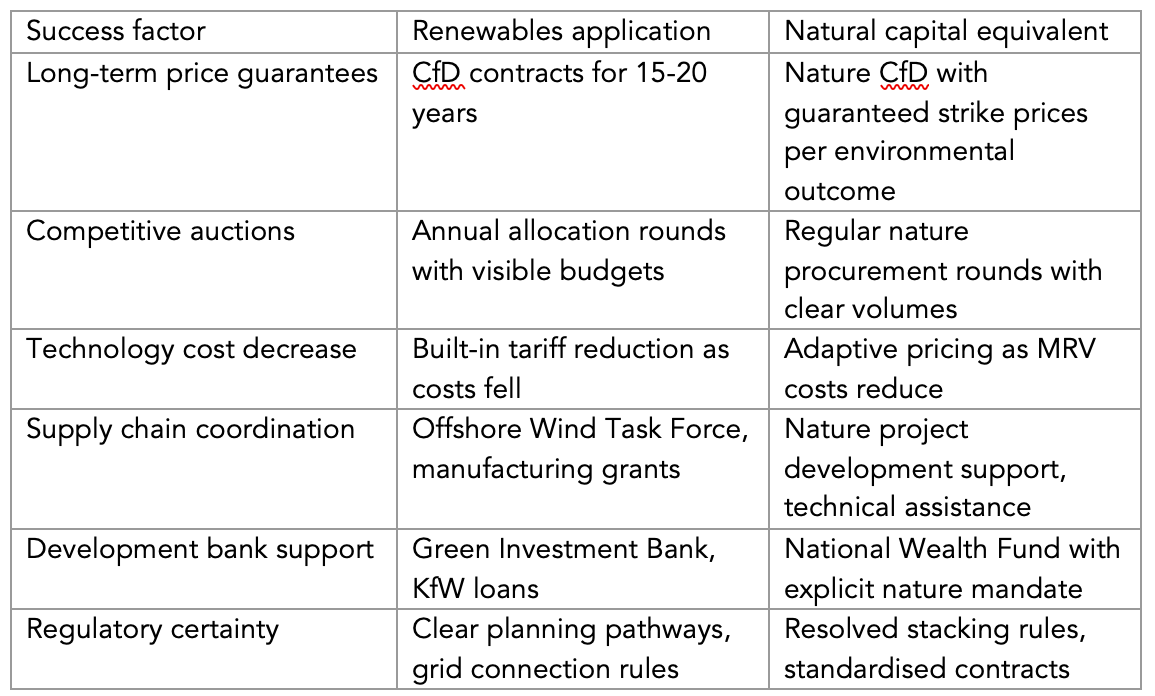
Germany’s Feed-in Tariff success was built on 20-year guaranteed prices, fine-tuned by technology type and site, with annual degression rates to incentivise innovation. This community-based approach saw most renewable infrastructure owned by private individuals and cooperatives, not large utilities, demonstrating that guaranteed prices can mobilise distributed investment at scale.
The economic growth dimension
The EIP 2025 acknowledges that nature-related risks could reduce UK GDP by up to 3% over the next decade (personally, I think it’s likely to be more). The Green Finance Institute (and others) estimates nature loss along supply chains could lead to a 12% drop in UK GDP over that timeframe. Yet the plan does not create the market mechanisms that would enable nature to be valued as infrastructure essential to economic resilience. Approximately 900 nature-related businesses currently operate in the UK, employing over 21,000 people and generating £2 billion in revenue. With appropriate policy frameworks, this sector could grow substantially, but only if revenue certainty enables investment at scale.
In summary, drawing from the renewables experience and broad stakeholder recommendations, a comprehensive natural capital policy framework would add greatly to the EIP:
Revenue certainty mechanisms
• Nature Contracts for Difference guaranteeing minimum prices per verified environmental outcome;
• Integration of Woodland Carbon Code credits into UK ETS; &,
• Long-term (20+ year) offtake agreements for ecosystem services.
Scaled public finance
• National Wealth Fund mandate explicitly including nature restoration;
• Adoption of J-Blue credit methodology;
• £500 million+ blended finance facility with first-loss capital; &,
• Project development grants for feasibility and technical assistance.
Demand creation
• Mandatory TNFD-aligned disclosures with iterative implementation timeline;
• Extension of mandatory nature markets beyond construction to high-impact sectors; &,
• Corporate nature-positive transition plans aligned with net zero plans.
Market infrastructure
• Clear, legally certain rules, built on verifiable additionality, on credit stacking and bundling;
• Aggregation platforms enabling small projects to reach bankable scale; &,
• Standardised contracts and project templates reducing transaction costs.
Pipeline visibility
• Annual nature procurement rounds with published budgets;
• Forward visibility of government purchasing intentions; &,
• Coordinated supply chain development similar to Offshore Wind Task Force.
A missed opportunity
I set out by asking whether the EIP would help us understand where the government really stands on Nature. The EIP 2025 provides targets and some public funding but sadly lacks the market architecture that transformed renewables from subsidy-dependent to cost-competitive and a fundamental building block of the economy. Without these mechanisms, the £56 billion annual Nature financing gap will persist (likely get wider), and the natural capital industry will remain nascent rather than scaling to meet the UK’s legal environmental commitments. The recent National Emergency Briefing was crystal clear – we must act now.